Remove competing sound
Pause conversations for instructions and turn off television, kitchen audio, or a second speaker.

 Back to the game
READABLE · AUDIBLE · UNHURRIED
Older adults do not share one playlist or one set of abilities. Ask what your players enjoy, remove avoidable barriers, and host a familiar game at a pace the room can follow.
THE FIVE-MINUTE ACCESS CHECK
Walk through these five checks before guests sit down. They improve the experience for everyone and do not require you to label or single out a player.
READABILITY
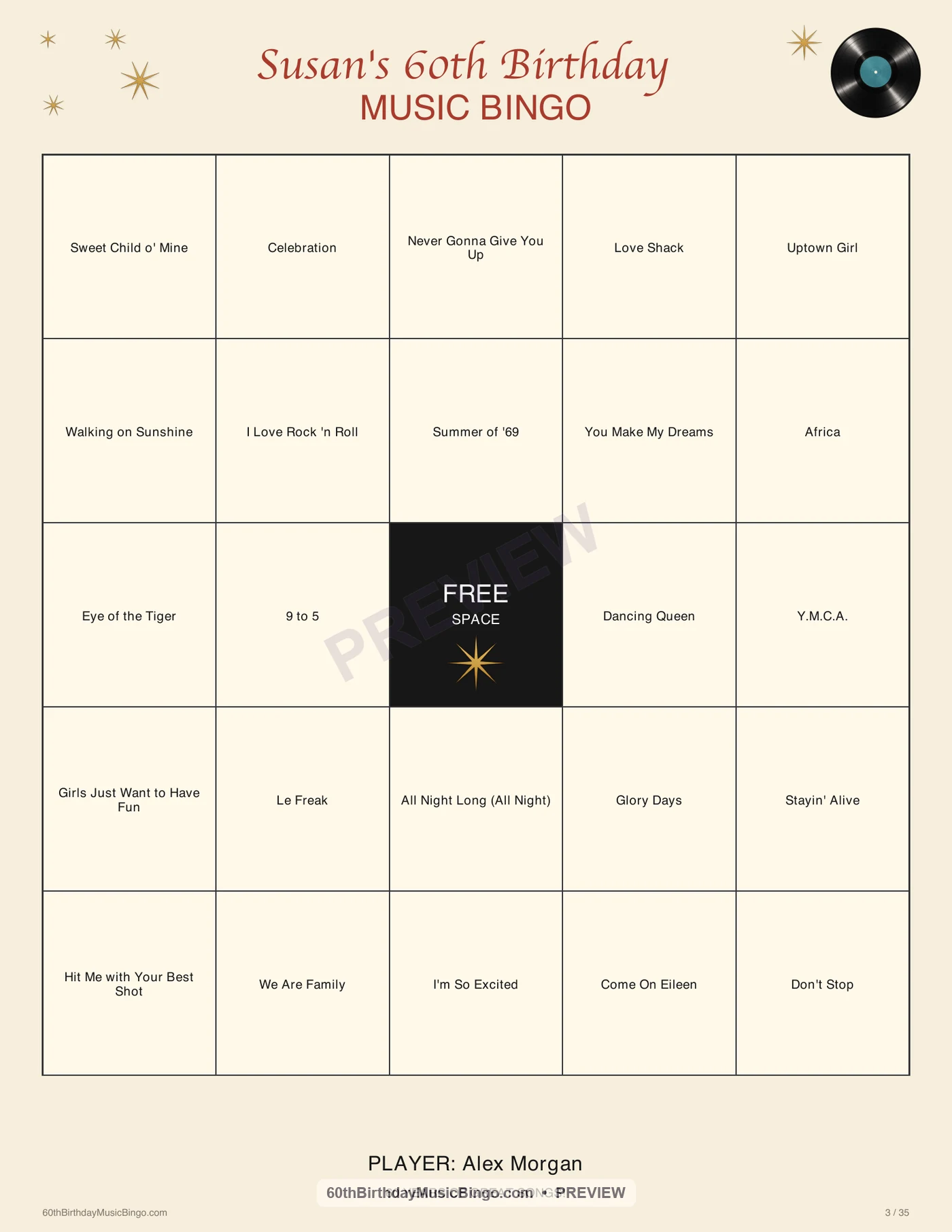
A screen preview cannot tell you how a title feels at arm’s length. Print at actual size, place the sample on the party table, and ask one of the intended players to try it.
COMFORTABLE SOUND
The National Institute on Aging notes that background noise can make speech harder to understand and recommends facing the listener, speaking clearly at a reasonable speed, and avoiding shouting. Apply the same principles when giving game instructions.
Pause conversations for instructions and turn off television, kitchen audio, or a second speaker.
Raise it above table obstacles, aim it toward the group, and avoid placing anyone directly beside it.
Play one practice song. Ask “Is this comfortable and clear?” instead of increasing volume automatically.
After marking time, lower or pause the music and clearly announce the song and artist before continuing.
Communication guidance: National Institute on Aging — Hearing Loss: A Common Problem for Older Adults.
A RELAXED 40-MINUTE ROUND
Recognition, scanning a card, and marking are three separate actions. The host controls the pace by leaving room for all three.
FAMILIAR TO THIS GROUP
Someone turning sixty in 2026 was born in 1966, but their strongest music memories may come from their teens, twenties, family celebrations, road trips, or later discoveries. Ask before you assume.
Collect three names or eras from the honoree and two or three guests.
Mix unmistakable openings, choruses, voices, and broad sing-alongs.
Do not turn the game into expertise in a single genre unless the whole group chose it.
Check the official playlist before the party and turn shuffle off during play.
HOST CHECKLIST
MUSIC BINGO FOR SENIORS FAQ
It can be an inclusive seated group activity when the cards are readable, the sound is comfortable, the rules are explained clearly, and the playlist is familiar to the actual group. Age alone does not determine musical taste or access needs.
Print cards at 100% scale on full-size paper, use strong light without glare, provide dark high-contrast markers, and let anyone who needs support play with a partner. Never shrink multiple cards onto one sheet.
Use the lowest level that lets the whole room recognize the music comfortably. Test from the farthest seat, reduce competing background noise, and ask guests whether the level is comfortable instead of assuming louder is clearer.
Choose songs the particular group knows and enjoys. Ask about favorite artists and meaningful decades, then include recognizable openings, varied voices, and a few broad sing-alongs. Do not choose music based only on age.
Often, yes, with individual accommodations such as a clear sightline to the host, reduced background noise, full-size cards, a partner, spoken song reveals, or an assistive listening setup. Ask the person what helps rather than deciding for them.
FAMILIAR MUSIC. CLEAR RULES. ROOM TO JOIN IN.
Select the number of players, add optional names, and review the complete personalized preview.
Create My Music Bingo Game